USWNT Looks to Build on Spain Series Ahead of World Cup Qualifying
The U.S. Women’s National Team, which fell 2-0 and then drew 2-2 against the reigning world champions, turns to Concacaf W Championship in November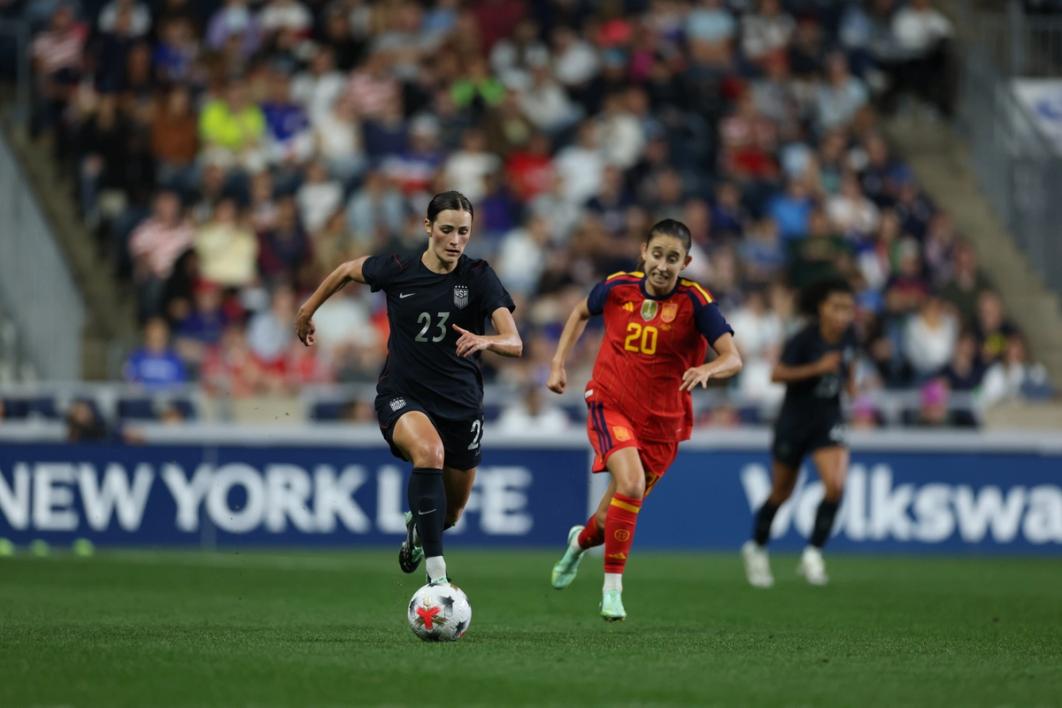
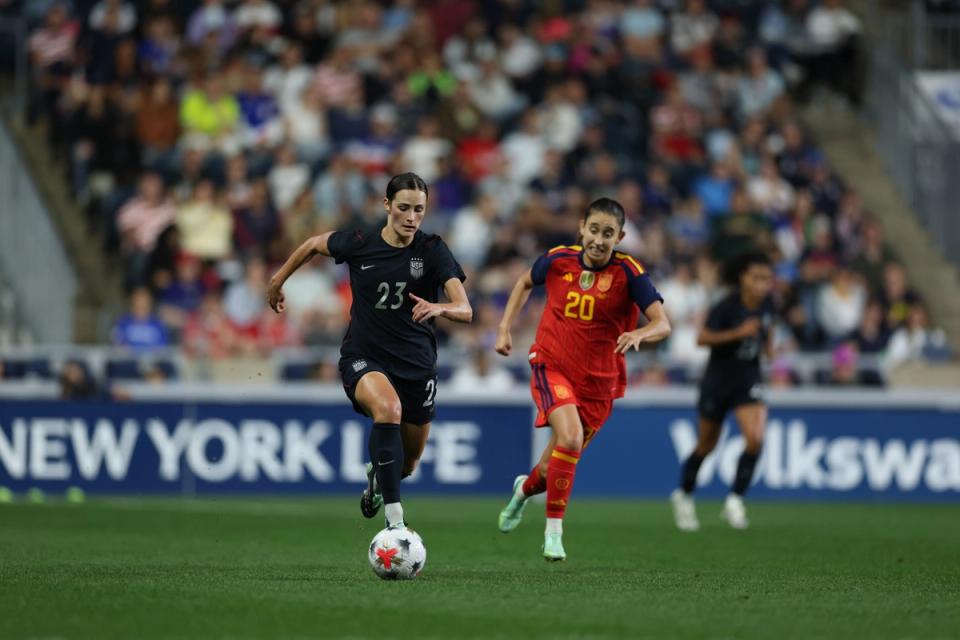
The U.S. Women’s National Team has spent the year preparing for the Concacaf W Championship that will take place in Texas from Nov. 27-Dec. 5, where a quarterfinal win would earn the team a berth to the 2027 FIFA Women’s World Cup in Brazil. Two matches against reigning world champions Spain in early October offered a final test before qualifying begins.
La Roja showed exactly why they are the No. 1 team in the world and came away with a 2-0 win on Oct. 10 in Washington, D.C. It looked like the World Cup champions were on their way to another one before the USWNT fought back to earn a 2-2 draw in the rematch three days later outside of Philadelphia.
Spain was the final opponent before World Cup qualifying in a challenging stretch for the USWNT, which has faced several of the world’s top teams since April. Head coach Emma Hayes viewed the series as an opportunity to identify areas for improvement before qualifying, emphasizing the lessons learned over the results themselves.
Against a team as technically skilled and cohesive as Spain, small defensive mistakes can result in significant consequences. Before the matches, Hayes emphasized the discipline required to disrupt an opponent whose movement and passing can quickly turn a mistimed press into a scoring opportunity.
“You're watching a synergy that has been developed over 10, 15 years,” Hayes said. “Being able to recognize in both attack and defense when to do the right things... it's not as simple as you know go all out. This is a team where if you press in the wrong moments, they pop the ball around you and create chances, so you have to be really, really diligent in your tactical preparation.”
The opening match illustrated how quickly Spain can capitalize on defensive lapses. Midfielder Patricia Guijarro scored from outside the box less than three minutes into the first match when given just a smidge of time and space. Eleven minutes later, Spain doubled the lead by sending a cross to forward Eva Navarro unmarked inside the box after the U.S. backline was pulled out of position. Those were the exact defensive breakdowns defender Kennedy Wesley said her side could not afford to do against Spain.
It’s not unusual for Spain to rack up multi-goal performances. In 29 matches over the last two years, the team has been held scoreless just three times while averaging over three goals per game. However, it’s considerably easier to find the back of the net when the ball rolls to two-time Ballon d’Or winner Alexia Putellas wide open in front of goal.
The USA also entered the series without veteran center backs Naomi Girma and Emily Sonnett, who were sidelined by injuries. Both U.S. starting backlines had not played together before the two matches, presenting an additional challenge against Spain’s attack. Still, Hayes stressed that the team must clean up the defensive mistakes when facing elite opponents.
“They're world champions for a reason,” Hayes said after the first match. “You're not going to just roll them over, but you can't give them head starts either. That's my message. Let's not give them a head start in giving away poor goals. Let them really earn it.”
Lack of precision in the final third has been a recurring challenge for the USWNT in recent months. The team was shut out against Japan in Seattle and fell to Brazil in São Paulo despite creating several quality chances. Against Spain, the same issue resurfaced in the opening match.
The U.S. placed 10 of its 13 shots on target, yet none crossed the goal line. Spanish goalkeeper Adriana Nanclares made numerous incredible saves, including one on a Lily Yohannes penalty kick in the 70th minute, but it was another match where the scoreline did not reflect the Americans’ attacking dominance.
“It just wasn’t meant to be, putting the ball in the back of the net, and it wasn’t for a lack of trying or lack of creation,” Hayes said. “It was technical quality, timing of the cross, over-dribbling when we’ve got to put an early ball into the box. Is it the right shot selection? I know we’ll keep getting better with this.”
The team did show improvement in the Oct. 13 meeting, scoring twice on six shots on target. The goals came from two players making returns to the USWNT after long absences – Ashley Sanchez, the NWSL’s current Golden Boot leader, and Mallory Swanson, whose 39th goal tied her with midfielder Lindsey Heaps for the most goals among active USWNT players.
Sanchez and Swanson created scoring opportunities across both matches, offering a glimpse of what their experience and finishing ability can bring to the attack. Swanson nearly scored on a chance reminiscent of her goal in the 2024 Olympic final before Nanclares made the save. Their returns provide more options for a team looking to become more clinical in front of goal.
“Mal has shown improvement every day in training,” Hayes said. "I say it all the time: she's an important player on our team, and I think the more we have her back, the better it will get.”
Pure. Joy. Mal Swanson 🫶 https://t.co/WyJ67P4Pf3
— U.S. Women's National Soccer Team (@USWNT) October 14, 2026
The USA also found a spark through its substitutions, particularly in the second half of the rematch. Hayes noted Michelle Cooper’s explosiveness and impact off the bench in both matches, with the forward setting up Swanson’s tying goal. Lily Yohannes and Jaelin Howell amped up the intensity in the midfield after subbing in the 66th minute, and Yohannes almost notched the game-winner in stoppage time.
Defender Kate Del Fava and forward Pietra Tordin both made their international debuts on Oct. 13 to become the 33rd and 34th players to earn first caps under Hayes. Del Fava played the long ball to Cooper on the second goal before making a crucial sliding save inside the six-yard box to preserve the draw.
“Sometimes it’s easier when you’re coming into a game like that,” Hayes said of Del Fava. “The job’s really clear, and you’ve got nothing to lose. I really admired the fearlessness of the performance in the second half. The importance is the whole pack, especially in a game where you have eight subs. In a World Cup, I don’t know what the sub pattern will be, but the bench is critical.”
Hayes has consistently emphasized the importance of developing depth across the team, particularly as player availability changes from one international window to the next. Not every player who contributed against Spain will be a part of the qualifying roster or a future World Cup squad, but their performances still provide value to the team.
For Hayes, the series reinforced the importance of building a group capable of competing with the world’s best, with contributions coming from both established veterans and less experienced players.
"(Spain is) deserving of being world champions,” Hayes said. “Our job is to hunt that, and I think we see the importance of the squad depth and how our players are really developing, especially the less experienced ones. The strength was in the size of our pack.”
"It took all of us to create this" https://t.co/fzv01pPRfS
— U.S. Women's National Soccer Team (@USWNT) October 16, 2026